
RELAY 6: SHIPS
Rediscovery — The Connector
From ruins rose memory, and from memory came renewal. Knowledge that had been scattered or silenced was rediscovered — manuscripts preserved in monasteries, oral traditions carried by custodians, fragments of wisdom stitched back together. Seven voices across ages became guardians of continuity, ensuring that the relay did not end in collapse. The pen itself emerged as infrastructure, transmitting intelligence across generations, restoring what stone and steel could not. In this chapter, mankind learned that rediscovery is not repetition but amplification — the act of weaving lost threads into new patterns, preparing the scaffold for the next ascent.
ACTIVE WEBS
EXCHANGE WEB
Global trade networks
KNOWLEDGE WEB
Navigation and maritime science
POWER WEB
Naval dominance and imperial expansion
CONSCIOUSNESS WEB
Global culture and interconnection
ICUT FOUR PILLARS
INFRASTRUCTURE
Ships, ports, shipyards, navigation systems, supply networks
CONTINUITY
Shipbuilding traditions and maritime knowledge
UNIFICATION
Naval organizations and global trade systems
THREATS
Piracy, storms, naval warfare, resource scarcity
HISTORICAL SIGNIFICANCE
Timeline: Approximately 2,000 years ago through the Age of Exploration (15th-18th centuries).
Impact: Enabled global trade networks, facilitated cultural exchange, and enabled European colonial expansion. Maritime civilisations became the dominant powers of the modern era.
Legacy: Modern shipping infrastructure remains critical to global commerce. Container ships, bulk carriers, and tankers are the direct descendants of ancient maritime infrastructure.
LA MENARA — THE REMARKABLE SHIP
Cultural Significance Across the Five Webs — REF-SHIPS-001
“The sea, once it casts its spell, holds one in its net of wonder forever.” — Jacques Cousteau
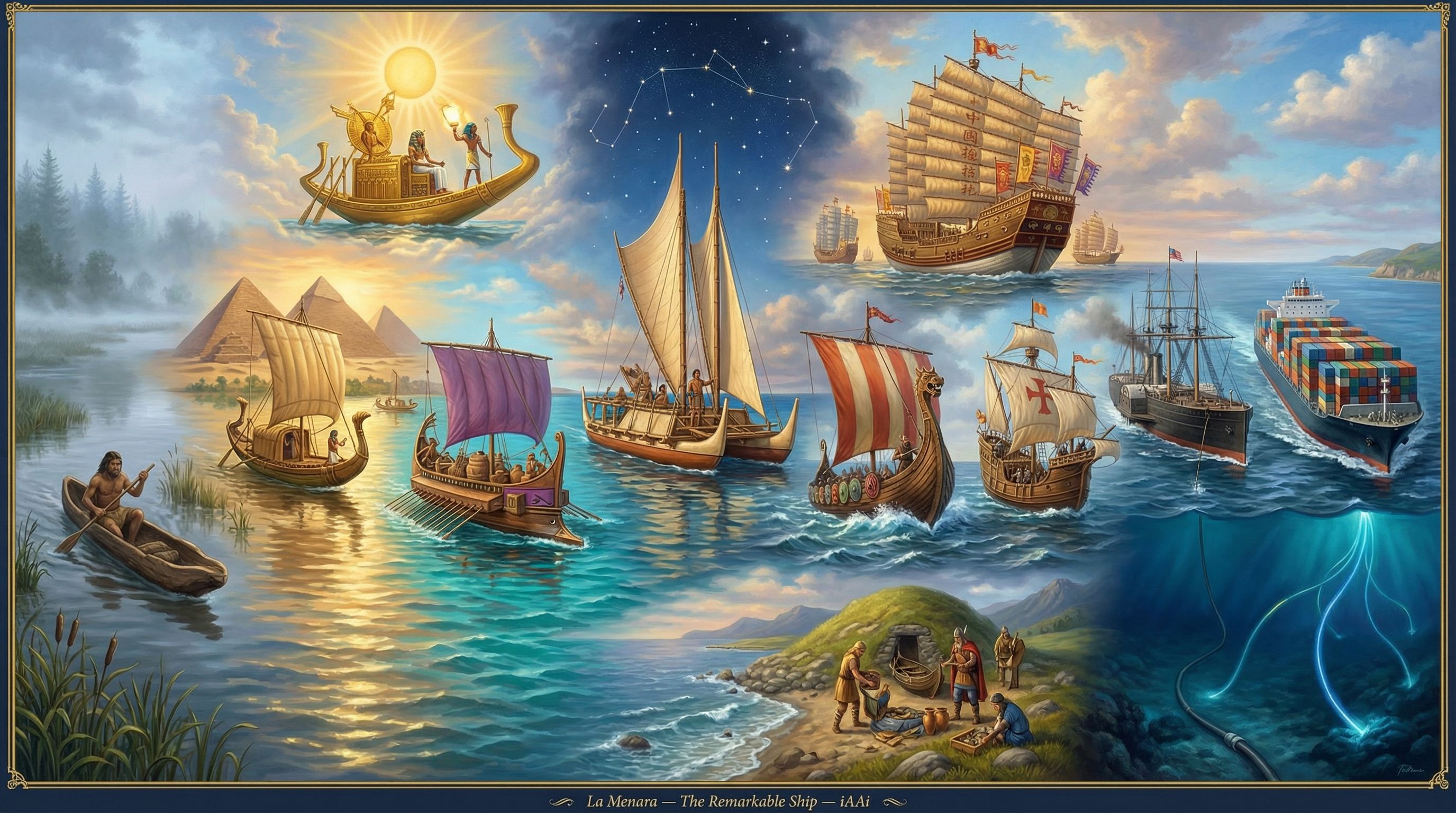
La Menara — The Remarkable Ship: From dugout canoe to container ship, 10,000 years of maritime infrastructure
The ship is the sixth civilisational relay — the infrastructure that made the world one. From the Pesse dugout canoe (8,000 BCE) to the modern container vessel carrying 90% of world trade, the ship transformed humanity from landlocked communities into a global civilisation. Every great empire was built on maritime power: Phoenicia controlled the Mediterranean through trade, Athens defeated Persia at Salamis, China projected power across the Indian Ocean with Zheng He’s treasure fleet, and Britain ruled a quarter of the globe through naval supremacy.
Across the Physical Web, the ship drove innovations from the keel and rudder to watertight compartments and containerisation. The Biological Web was transformed through fishing, the spice trade, the conquest of scurvy, and refrigerated shipping. The Digital Web owes its existence to maritime infrastructure — Polynesian stick charts were the first navigational data systems, ship logs created the first systematic weather records, and today 95% of the world’s internet traffic flows through submarine cables laid by ships. The Social Web was shaped by maritime law (the Rhodian Sea Law of 800 BCE), UNCLOS, and the naval empires that drew the modern map. The Consciousness Web carries the deepest imprint: ship burial rites from Egypt to Scandinavia, the Ship of Theseus as philosophy’s foundational paradox, and the Polynesian waka as living cultural identity.
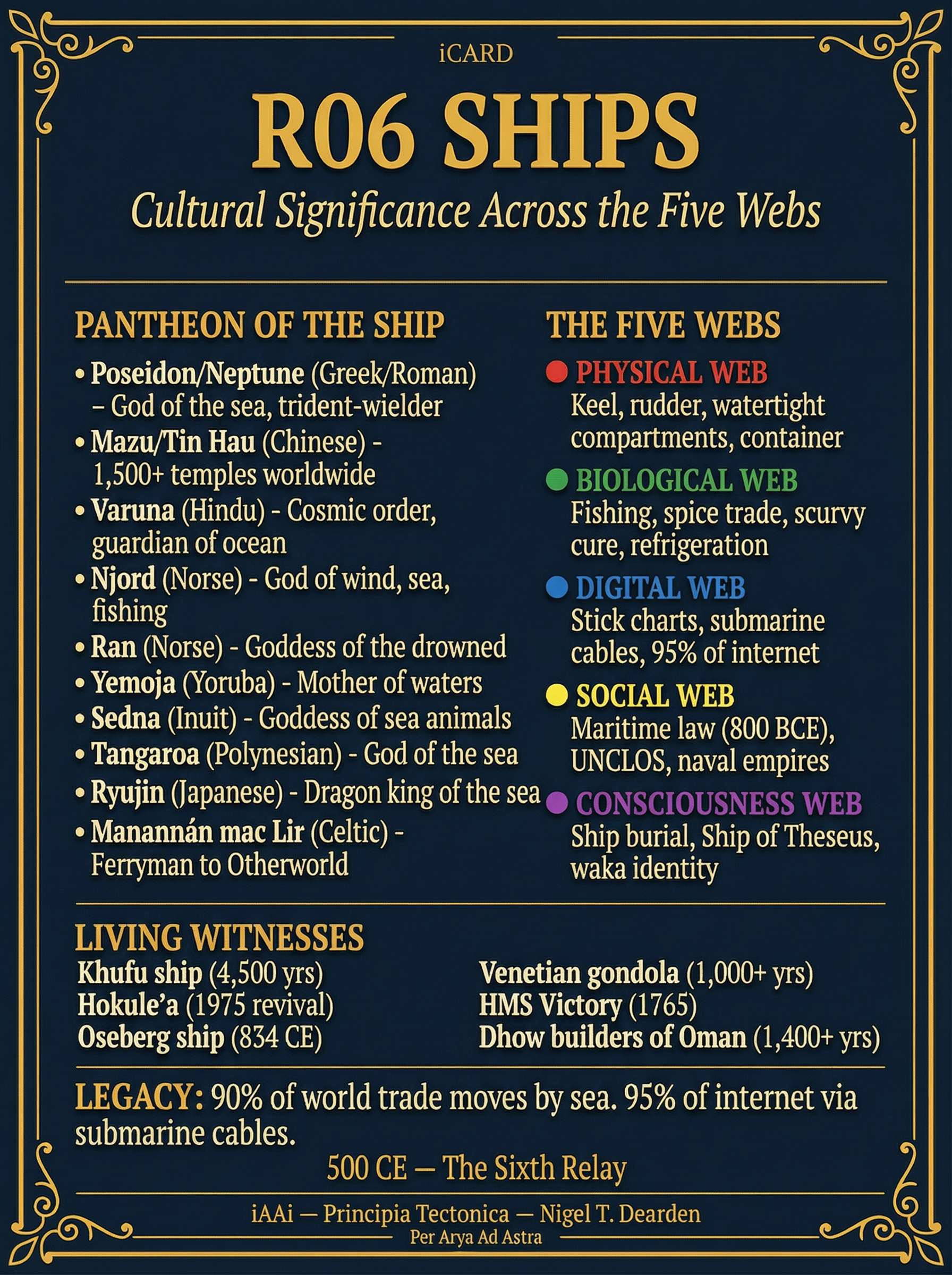
iCard R06 — Ships: Cultural Significance Across the Five Webs
THE COUNTERPARTS: SHIPS
How West, East, and Outrider each approached ships infrastructure

The Counterparts — Relay 06: Ships