
THE FRAMEWORK
A Civil Engineer's Analytical Framework for 12,000 Years of Civilisational Infrastructure

The Complete Framework: Perspective → Guide → Game. “The Journey Is The Work.”
THE THREE MODES
Three distinct approaches to infrastructure across 12,000 years — viewed through the lens of civil engineering

The Three Modes: West (Discontinuous/Built), East (Continuous/Built), Outrider (Semi-Continuous/Temporary Works)
MODE 1: THE WEST
The West built permanent infrastructure — roads, aqueducts, bridges, cities — but failed to maintain them across civilisational transitions. When empires collapsed, institutional knowledge was lost. The next Western civilisation had to reinvent or rediscover from scratch. Roman concrete (37 BCE) was lost after the Western Roman Empire collapsed (476 AD) and not rediscovered until the Renaissance — a 1,000-year gap.
The lifecycle cost was not paid. Permanence must be maintained at a cost — and that cost is money. When money gets diverted from infrastructure to war and weapons, the infrastructure decays. The West built brilliantly, but each successor civilisation started again. River Systems → Rome → Gap/Decline → Britain → Gap → USA. Different powers at different temporal anchors with gaps between.
Roads let armies march and goods transport — but roads also let invaders in. The infrastructure that enabled expansion also enabled collapse. The Western pattern: Invention → Collapse → Reinvention.
See also: TP-009: The Permanence Crisis — a live Turing Test demonstrating that the permanence problem is not limited to physical infrastructure. Digital artefacts face the same lifecycle cost. When maintenance stops, digital infrastructure decays just as Roman concrete did.

The Western Timeline: 12,000 years of discontinuous civilisation — brilliant peaks separated by collapse
MODE 2: THE EAST
The East built permanent infrastructure AND maintained it without interruption for 12,000 years. Each dynasty refined and improved what came before. Written documentation, scholarly custodianship, and systematic deployment ensured that institutional knowledge was never lost. Papermaking (105 AD) was continuously refined over 1,500 years, leading to printing and woodblock printing.
The lifecycle cost was paid continuously. China is THE COUNTERPART reflecting endurance. Agriculture → Yellow River → Qin → Han → Tang → Song → Yuan → Ming → Qing → Century of Humiliation → Modern China. One continuous thread. Knowledge persistence: 2,000+ years of institutional continuity.
The Eastern pattern: Invention → Continuous Refinement → Compounding Advantage. The advantage compounds because nothing is lost. Each generation builds on the last.

The Eastern Timeline: 12,000 years of continuous civilisation — the lifecycle cost paid without interruption
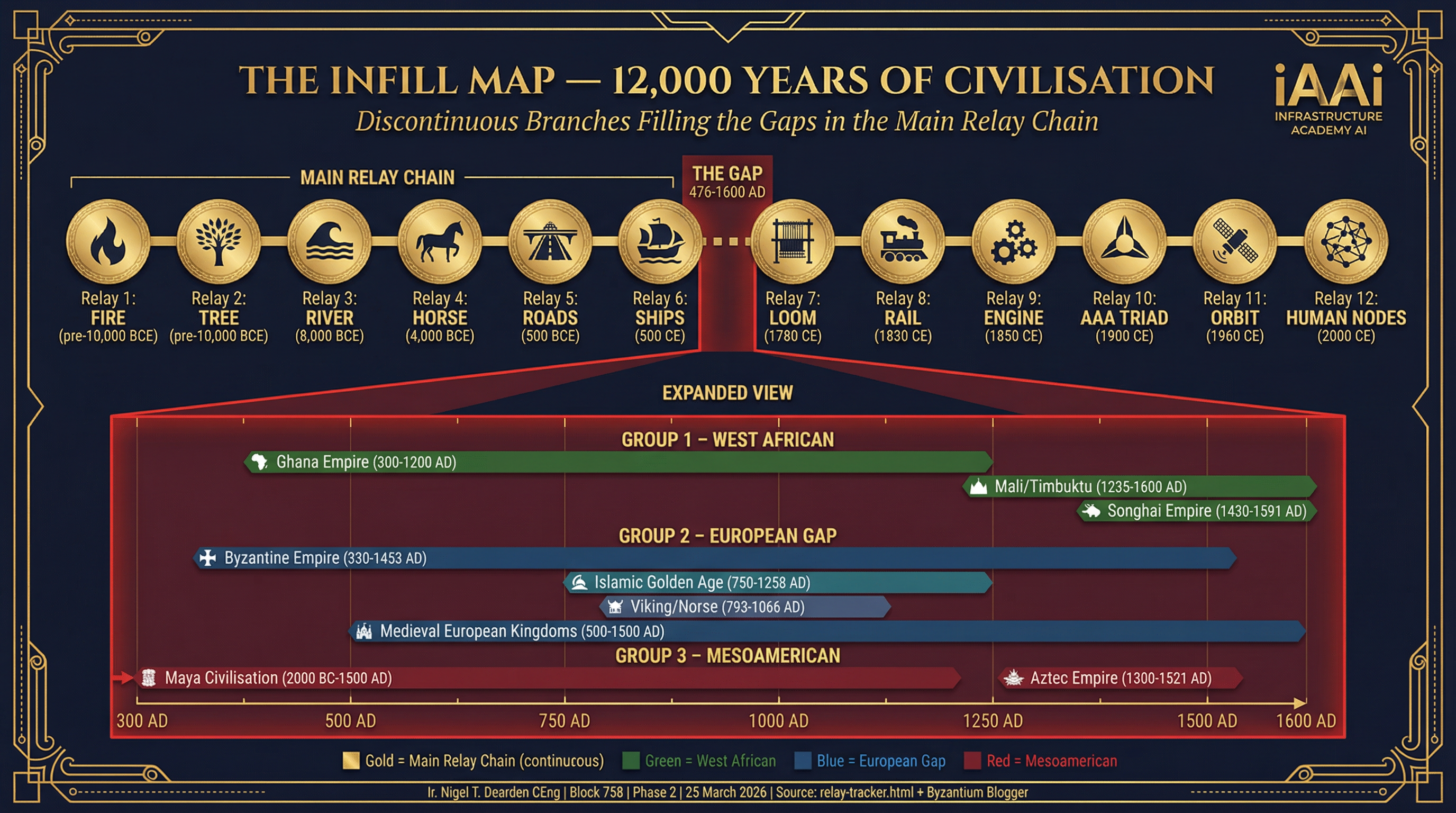
The Infill Map v6: Magnifying glass expansion of THE GAP (476–1600 AD) between Ships and Loom — West African (green), European Gap (blue), Mesoamerican (red). 10 discontinuous branches that held the line before the Industrial Revolution. Block 758 • Phase 2.
MODE 3: THE OUTRIDER
The Outrider built ONLY temporary works — tented shelters, portable camps, mobile infrastructure — all fit for purpose and environment. This was not a failure to build; it was a deliberate choice. In civil engineering, temporary works is a recognised discipline. The Outriders were the ultimate temporary works civilisation.
They didn't need roads — they stole from others and controlled trade routes. The horse/grass symbiosis was their platform. Horse domestication (~4000 BC) was the enabling infrastructure. They were the ultimate biomimicry civilisation — living in harmony with the grassland ecosystem, moving with the seasons, building nothing that couldn't be packed onto a horse.
Lifecycle cost: zero. Temporary works have no maintenance burden. When you move on, you leave nothing behind to decay. Seven Steppe Outrider Zeniths: Scythians → Xiongnu → Sarmatians → Huns → Gökturks → Khitans → Mongol Empire. The Mongol Empire was the natural civilisation at its absolute peak — the largest contiguous land empire in history, built without building anything permanent.
West and East both built cities — fixed targets. The Outrider smashed both by living on horses, being mobile, attacking when they chose. Cities couldn't move. But the Outriders were also the BRIDGE that connected East and West, transmitting technology and culture across the gap. The Silk Road paradox: the Outrider controlled the trade routes but built none of the infrastructure.
Killed by rail and firearms — technologies that made the horse obsolete as a military platform. But the culture endures today. And it was reborn as the Digital Outrider.

The Outrider Timeline: Seven Steppe Zeniths across 12,000 years — temporary works civilisation at its peak
THE SILK ROAD PARADOX
The Outriders controlled the trade routes but built none of the infrastructure

Static vs Mobile — settled civilisations built the goods, Outriders moved them

The Outrider Bridge — connecting East and West, transmitting technology across the gap
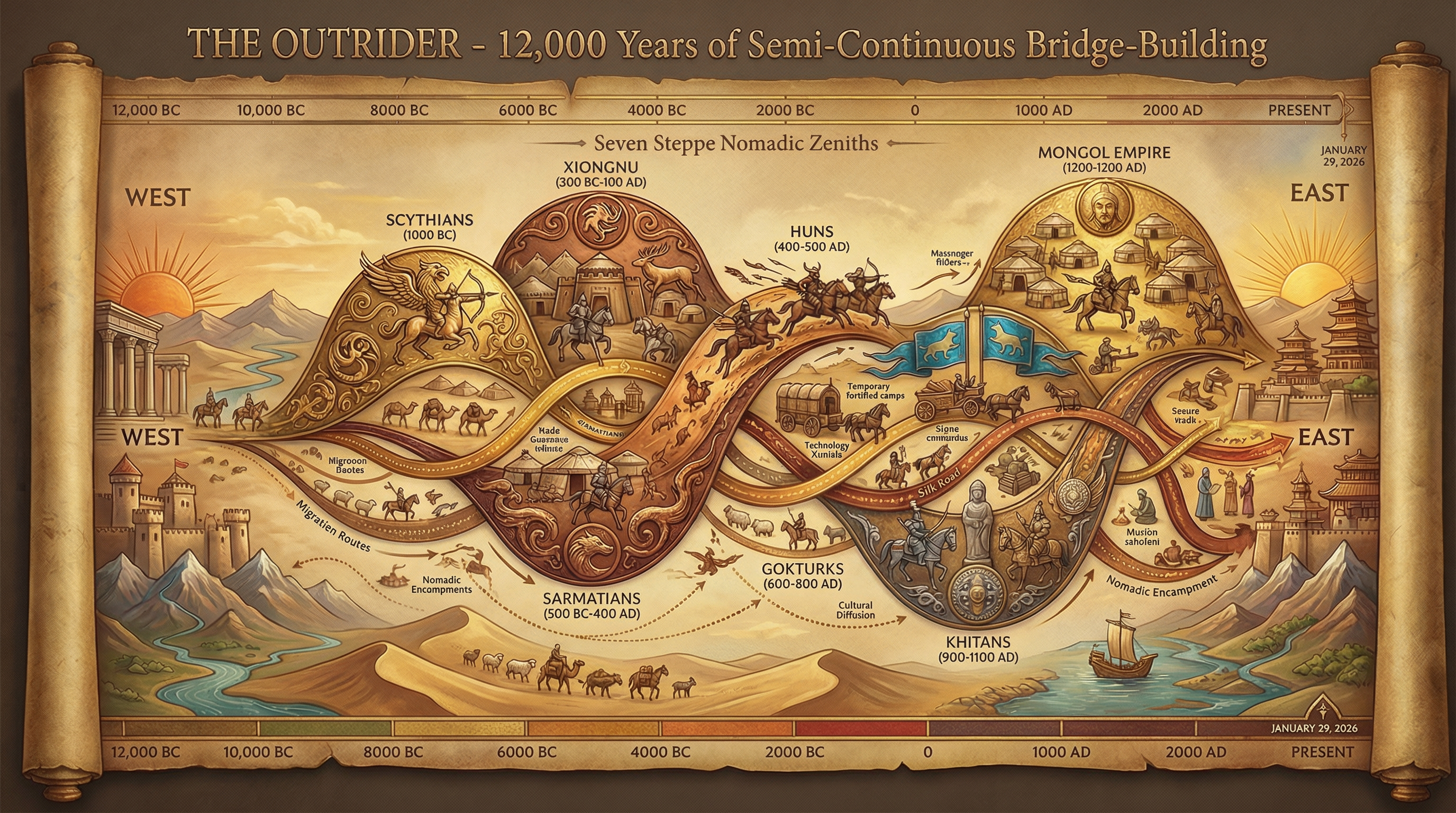
The Outrider — 12,000 Years of Semi-Continuous Bridge-Building: Seven Steppe Zeniths from Scythians to Mongol Empire

Civilisational Modes Patterns — how the three approaches interact across history
MODE 4: UNIFIED
There is no right or wrong mode. Each was fit for purpose in its time and environment. The true fourth mode is unified and united — combining the best of all three. This is the aspiration of Episode 2: The Gray Arena, where cybernetics, AI, and intelligent systems offer the possibility of a civilisation that builds, maintains, adapts, and connects simultaneously.
LIFECYCLE COST COMPARISON
| DIMENSION | WEST (Discontinuous) | EAST (Continuous) | NOMAD (Temporary) |
|---|---|---|---|
| INFRASTRUCTURE TYPE | Permanent Works | Permanent Works | Temporary Works |
| LIFECYCLE COST | Not paid — diverted to war | Paid continuously for 12,000 years | Zero — nothing to maintain |
| CONTINUITY | Episodic — peaks and collapses | Unbroken institutional thread | Semi-continuous — culture endures |
| KNOWLEDGE | Lost between empires | Preserved institutionally | Oral tradition, very little written |
| PLATFORM | Roads, cities, harbours | Canals, walls, bureaucracy | Horse, grass, open steppe |
| MODERN ECHO | USA — global power, ageing infrastructure | China — 15th Five-Year Plan (75 years) | Digital Outrider — rides invisible infrastructure |
FRAMEWORK QUICK REFERENCE
The numbered frameworks at a glance — what each one is and how they relate
| FRAMEWORK | COUNT | MEMBERS | ROLE IN THE LOOM |
|---|---|---|---|
| The Great Webs | 5 | Energy, Knowledge, Exchange, Power, Consciousness | WARP — vertical threads |
| The Framing Pillars | 4 | Infrastructure, Continuity, Unification, Threats | WEFT — horizontal threads |
| 4 Perennial Threats | 4 | Conflagration (War), Contagion (Disease), Consumption (Famine), Climate (Existential) | Content of the Threats weft thread |
| The Civilisational Relays | 12 | Fire → Tree → River → Horse → Roads → Ships → Loom → Rail → Engine → AAA Triad → Orbit → Human Nodes | The timeline — 12,000 years |
| The Three Modes | 3 (+1) | West, East, Outrider (+Fourth: Unified) | Civilisational patterns |
| The Counterparts | 12 | The Counterparts comparison for each relay | East–West comparison |
| The Three Leaders | 3 | Alexander (West), Genghis Khan (Outrider), Qin Shi Huang (East) | Modal exemplars |
THE 5 GREAT WEBS OF CIVILISATION
THE WARP THREADS
Five vertical threads that run the length of civilisation — the structural backbone of the Loom
1. ENERGY WEB
The systems that generate, distribute, and consume power. From fire and biomass to fossil fuels and renewable energy. Control of energy sources determines civilisational capacity and strategic advantage.
2. KNOWLEDGE WEB
Information systems, education, and learning frameworks that preserve and transmit knowledge. The Knowledge Web determines whether civilisations maintain continuity or collapse into ignorance.
3. EXCHANGE WEB
Trade, commerce, and economic systems that enable value creation and distribution. Markets, currencies, and supply chains are its modern expressions.
4. POWER WEB
Political systems, governance, and control structures that organise societies. Hierarchies, laws, and institutions shape the Power Web's architecture.
5. CONSCIOUSNESS WEB
Culture, art, philosophy, and meaning-making systems that define civilisational identity. Art, literature, and religion are its expressions.
THE 4 FRAMING PILLARS
ANALYTICAL LENSES
Four horizontal threads that cross-cut every Web — the analytical lenses woven through the Loom
INFRASTRUCTURE
The physical systems and built environment that enable civilisation. Roads, bridges, aqueducts, buildings, and all engineered systems.
CONTINUITY
Knowledge preservation and transmission across generations. Written records, institutions, and scholarly traditions maintain continuity.
UNIFICATION
Integration and connection of systems and peoples. Roads unify territories, common languages unify peoples, shared values unify societies.
THREATS
The 4 Perennial Threats — War, Disease, Famine, Existential — test every relay. These are not abstract historical patterns; they are active planetary forces with measurable signatures on humanity's ecological balance sheet. Each relay chapter maps all four threats to its specific infrastructure context.
THE WARP × WEFT MATRIX
THE LOOM — 9 THREADS WOVEN
5 Warp threads (vertical Webs) × 4 Weft threads (the 4 Perennial Threats) = the civilisational fabric. This is Relay 7: the Loom.
| WEFT ↓ / WARP → | ENERGY | KNOWLEDGE | EXCHANGE | POWER | CONSCIOUSNESS |
|---|---|---|---|---|---|
| INFRASTRUCTURE | Power plants, grids | Libraries, schools | Markets, roads | Palaces, courts | Temples, monuments |
| CONTINUITY | Fuel sources | Written records | Trade routes | Laws, traditions | Stories, myths |
| UNIFICATION | Shared power | Common language | Common currency | Central authority | Shared values |
| THREATS | Depletion | Loss of records | Disruption | Fragmentation | Dissolution |
THE 12 CIVILISATIONAL RELAYS
12,000 years of infrastructure development told as a continuous relay race

The 12 Civilisational Relays: Fire → Tree → River → Horse → Roads → Ships → Loom → Rail → Engine → AAA Triad → Orbit → Human Nodes

The Complete Journey: 12,000 Years of Civilisational Relays

The 12 Civilisational Relays + Prologue & Epilogue: 12,000 Years Timeline

All Three Timelines Combined — West, East, and Outrider overlaid on a single 12,000-year canvas

Primal Element Transitions (PET) — how energy types evolve across the 12 relays
THE 4 PERENNIAL THREATS
THREATS — THE FOURTH WEFT THREAD
The four existential threats that test every civilisational relay. War, Disease, Famine, Existential. The 4 Perennial Threats are the content of the Threats pillar.
1. CONFLAGRATION (War)
Conflict destroys infrastructure assets but historically accelerates rebuilding and consumption. War reshuffles the deck but does not shrink it. The post-WWII boom drove the greatest infrastructure expansion in history. War attacks the built environment; the knowledge to rebuild often survives.
2. CONTAGION (Disease)
The only Horseman that attacks biological intelligence assets directly — the operators, not the infrastructure. The Plague of Athens, the Antonine Plague, the Black Death, COVID-19 — each removed operators while leaving machines standing. COVID-19 pushed Earth Overshoot Day back 24 days in 2020 — the first measurable reversal.
3. CONSUMPTION (Famine)
Resource depletion collapses demand locally but triggers infrastructure expansion elsewhere. Drought affects agriculture, which affects food supply, which affects trade, which affects power. The cascade is real, but famine also drives innovation — irrigation, crop rotation, the Green Revolution.
4. CLIMATE (Existential)
Threats that target both infrastructure and operators simultaneously — climate change, asteroid impact, AI misalignment, nuclear war. The Torus question of Relay 12: can consciousness-level infrastructure achieve what COVID achieved deliberately and permanently, without catastrophe as the mechanism?
THE COUNTERPARTS
A three-way comparison — reflecting how West, East, and Outrider approached the same infrastructure challenges differently
THE COUNTERPARTS — PER RELAY

Relay 1: Fire

Relay 2: Tree

Relay 3: River

Relay 4: Horse

Relay 5: Roads

Relay 6: Ships

Relay 7: Loom

Relay 8: Rail

Relay 9: Engine
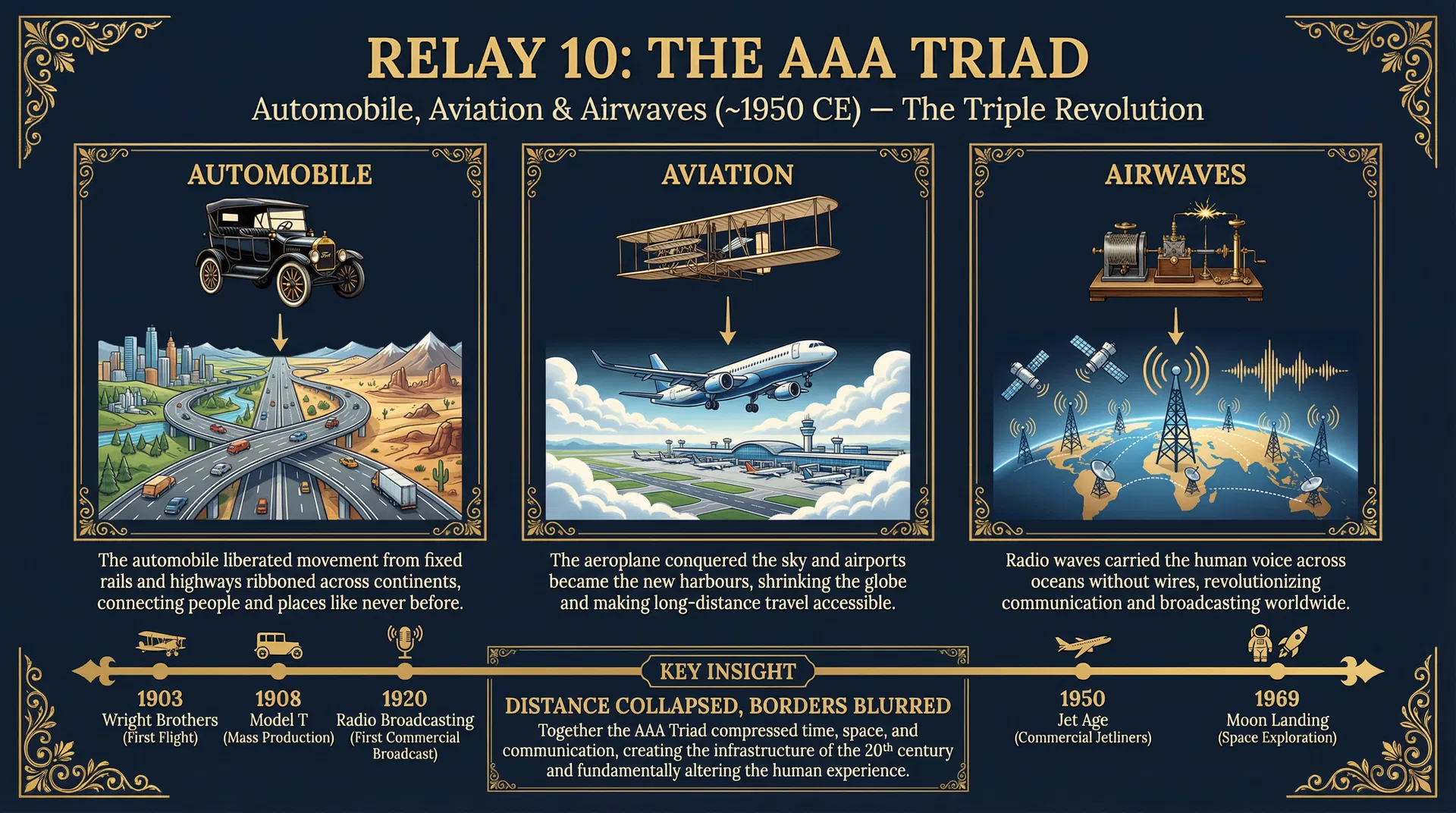
Relay 10: AAA Triad

Relay 11: Orbit

Relay 12: Human Nodes
THE KNOWLEDGE WEB
Writing Systems, Number Systems, Materials & Mediums — the infrastructure of knowledge itself

The Pen IS Infrastructure — the written word as the foundation of civilisational continuity

Opening Overture

Master Map — Complete Writing Systems Overview

Materials & Mediums — Durability Hierarchy

Accounting Phase — Tokens, Tallies, Early Record-Keeping

Narrative Phase — Storytelling & Cultural Transmission

Printing to Modern — Gutenberg Through Digital Age

Number Systems — Mathematical Notation Evolution

Civil Engineering — Infrastructure of Knowledge Itself

Writing Systems Evolution — from cuneiform to digital
THE THREE LEADERS
Alexander the Great (West) • Genghis Khan (Outrider) • Qin Shi Huang (East)

The three civilisational archetypes: Expansion (West), Bridge (Outrider), Consolidation (East)
THE EDUCATION CHALLENGE
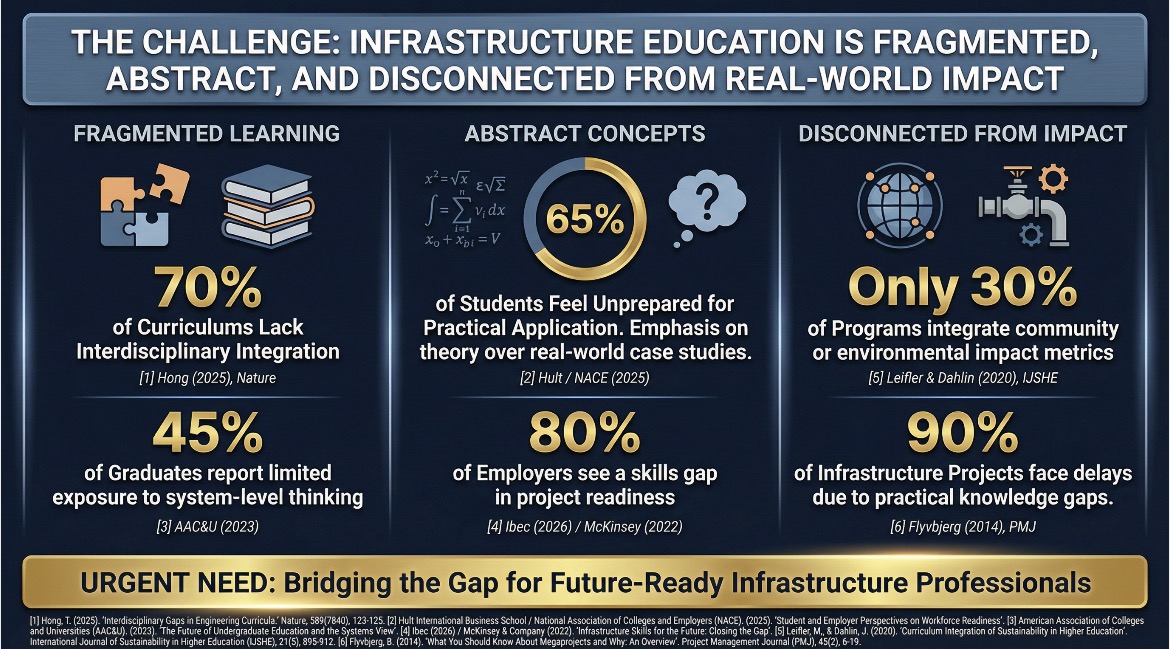
The Infrastructure Education Challenge — why this work exists

The Trilogy Vision: Episode 1 (Available) → Episode 2 (Coming Soon) → Episode 3 (Coming Soon)
THE CIVILISATIONAL DIVIDE
TRUST PROFESSIONS vs BELIEF PROFESSIONS
The foundational distinction that explains why infrastructure is invisible, why finance dominates headlines, and why a civil engineer’s perspective is essential
TRUST PROFESSIONS
Engineers, Doctors, Pilots, Architects, Builders. Judged by physics, not opinion. They deal in load paths, failure modes, tolerances, safety factors, consequences, and stewardship. Their work is invisible because it is stable. When a structure stands for 100 years, the engineer disappears into the background of civilisation. The more essential the profession, the more invisible it becomes.
BELIEF PROFESSIONS
Finance, Markets, Media, Politics, Branding. Judged by sentiment, confidence, narrative, perception, and momentum. Their work is visible because it is performative. Finance is in the headlines because it trades in motion, not endurance. If they are wrong, the story collapses — not the world. A mispriced asset hurts investors. A misdesigned structure kills families.
Every relay in the Infrastructure Odyssey — from Fire to Human Nodes — is a trust-layer artefact. Finance cannot exist without roads. Markets cannot exist without ships. Digital currency cannot exist without the Engine relay. The relay sequence is the trust sequence. The belief layer only emerges after the trust layer is established. Civilisation fails when belief professions outrun trust professions.
THE 14+42 LIFECYCLE & THE DIVIDE
IGNITION PHASE (14 YEARS)
During the formative years, learners are taught to distinguish what is real from what is narrative, what is structural from what is performative, what is load-bearing from what is noise. This becomes a core literacy — the ability to see through the belief layer to the trust layer beneath. A 14-year-old who completes the iGO game understands that the road they walk on, the water they drink, and the building they sleep in were designed by someone they have never met.
APPLIED LIFE PHASE (42 YEARS)
Graduates of the Ignition Phase become builders, stewards, system architects, long-term thinkers, and custodians of the real. They carry the civil engineer’s worldview into every profession — not because they all become engineers, but because they understand the difference between trust and belief, between structure and story, between the skeleton and the skin.
EXPLORE MORE
Deep analysis: The Counterparts thesis evidence, institutional continuity, and future vision
READThe narrative foundation — 12 relay chapters from Fire to Human Nodes
READThe practical framework — 4 Pillars per relay, The Counterparts per chapter
READComplete glossary of all framework terms, relay names, and academic references
VIEWHomer, Confucius, Sun Tzu, Aristotle, Sima Qian, Marco Polo & the Modern Scholar
VIEWIdentify, Understand, Manage, Control — per-relay analysis diagrams in Volume 2: Guide
READOnboarding guide, curriculum overview, and recommended learning paths
BEGINWhy infrastructure is invisible, why finance dominates, and why a civil engineer’s perspective matters
READSUSTAINABLE DEVELOPMENT GOALS — ALIGNMENT
How IAAI's 12-relay curriculum maps to the United Nations Sustainable Development Goals


IAAI content directly addresses 11 of the 17 Sustainable Development Goals. Each icon links to the official UN goal page.
| IAAI RELAY | SDG GOAL(S) | ALIGNMENT RATIONALE | 5P CATEGORY |
|---|---|---|---|
| R1: Roads |
|
Road networks are the circulatory system of economic development. Without roads, no market access, no emergency services, no supply chains. | PROSPERITY |
| R2: Rail |
|
Rail is the backbone of mass transit and freight. Lower emissions per tonne-km than road, enabling sustainable urbanisation. | PROSPERITY |
| R3: Ports |
|
Ports connect nations to global trade. 90% of world goods move by sea. Port infrastructure directly impacts marine ecosystems. | PROSPERITY PLANET |
| R4: Airports |
|
Aviation infrastructure enables global connectivity, trade, tourism, and emergency response. Gateway to economic participation. | PROSPERITY |
| R5: Water |
|
Clean water is the most fundamental infrastructure. 2.2 billion people still lack safely managed drinking water. Every civilisation rises or falls on water. | PEOPLE PLANET |
| R6: Sanitation |
|
Sanitation prevents disease, protects water sources, and preserves human dignity. 3.6 billion people lack safely managed sanitation. | PEOPLE |
| R7: Energy |
|
Energy infrastructure determines whether nations industrialise cleanly or repeat fossil-fuel dependency. The transition relay. | PLANET PROSPERITY |
| R8: Telecoms |
|
Telecommunications connect people to education, markets, and governance. The digital divide is an infrastructure divide. | PROSPERITY PEOPLE |
| R9: Waste |
|
Waste management is the mirror of consumption. Circular economies require infrastructure for collection, sorting, recycling, and recovery. | PLANET |
| R10: Health |
|
Health infrastructure — hospitals, clinics, supply chains — determines whether populations survive pandemics and age with dignity. | PEOPLE |
| R11: Education |
|
Educational infrastructure — schools, universities, libraries — is the mechanism by which civilisations transmit knowledge across generations. | PEOPLE PARTNERSHIP |
| R12: Digital |
|
Digital infrastructure — data centres, fibre, cloud — is the 21st-century equivalent of roads and ports. The new commons. | PROSPERITY PEOPLE |
The UN frames the 17 SDGs through five pillars known as the 5Ps. Infrastructure is the mechanism by which civilisations deliver on all five. Every relay in IAAI's curriculum touches at least one P — most touch two or three. This is not coincidence; it is the nature of infrastructure as civilisational stewardship.