
RELAY 4: HORSE
Empire — The Liberator
From networks of exchange rose the skeletons of power. Three great empires — West, East, and the in-between — expanded, consolidated, and collapsed in cycles of continuity. Cities became hubs of permanence, aqueducts carried lifeblood across landscapes, and monumental works proclaimed dominion. Infrastructure was no longer just survival or trade; it became the architecture of authority, the engineered skeleton of civilisation itself. In this relay, mankind learned that power could be built, scaled, and immortalized in stone — yet always at risk of fracture when ego eclipsed unity. Empire was both triumph and warning, a reminder that only through conscious design could greatness endure.
ACTIVE WEBS
ENERGY WEB
Animal power for transportation and labor
EXCHANGE WEB
Long-distance trade and communication
POWER WEB
Military conquest and territorial control
ICUT FOUR PILLARS
INFRASTRUCTURE
Stables, breeding grounds, supply systems, roads
CONTINUITY
Breeding programs and knowledge transmission
UNIFICATION
Cavalry organizations and military structures
THREATS
Disease, resource scarcity, military disruption
HISTORICAL SIGNIFICANCE
Timeline: Approximately 4,000 to 3,000 years ago, with significant development continuing through the medieval period.
Impact: Enabled rapid military conquest, long-distance trade, and the rise of outrider empires. Changed the balance of power between settled and outrider peoples.
Legacy: Horse infrastructure evolved into motorized transportation. The principles of mobility and logistics established by horse infrastructure continue to shape modern civilisation.
LA MENARA: THE REMARKABLE HORSE
The Animal That Steered Civilisation — Across the Five Webs
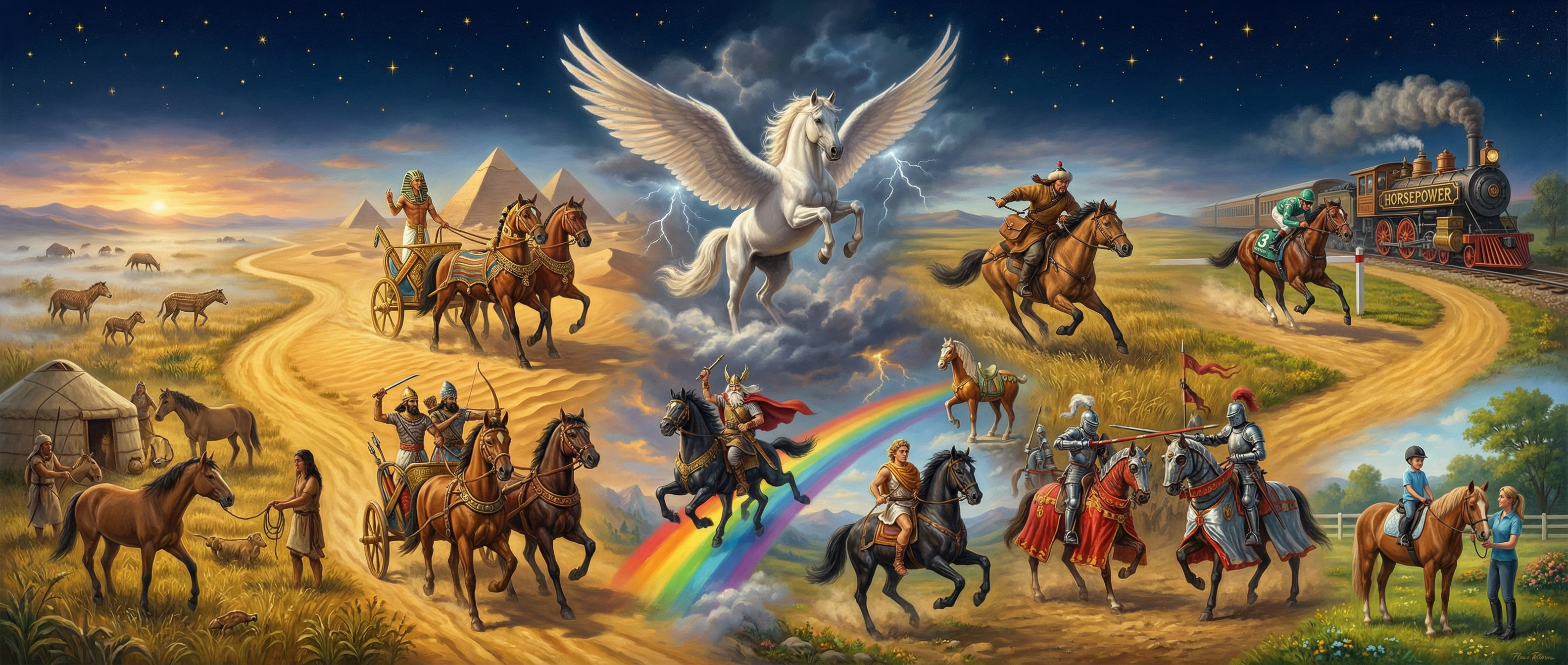
La Menara — The Remarkable Horse: From Botai Steppe to Horsepower
Of all the animals humanity has domesticated, none has reshaped the trajectory of civilisation more profoundly than the horse. When humans first climbed onto the back of a horse on the Kazakh steppe around 4,000 BCE, they gained the ability to compress distance, project force, transmit information, and reshape the political geography of the planet. The reins of a horse represent the first command-and-control interface in human history — a mechanism by which a rider could direct a powerful force with precision, at speed, over distance. Every steering mechanism that followed — the ship's tiller, the helm wheel, the train lever, the steering wheel, the joystick, the touchscreen — descends conceptually from the simple leather strap that connected a rider's hand to a horse's mouth.
Across the Physical Web, the horse gave humanity the chariot, cavalry, the plough, pack transport, and ultimately the unit of horsepower that still measures every engine on Earth. In the Biological Web, selective breeding produced over 350 breeds, founded veterinary medicine, and mare's milk sustained steppe civilisations. The Digital Web owes its earliest postal relay systems to the horse — the Mongol Yam network could transmit a message 200 miles per day across an empire spanning 24 million square kilometres. In the Social Web, the horse created the equestrian class, shaped law (horse theft was a capital offence in most cultures), and built the global racing and sport industries. And in the Consciousness Web, the horse became Pegasus, Sleipnir, Buraq, the Four Horsemen, and the white horse of prophecy — the animal that carries gods, heroes, and souls between worlds.
James Watt defined one horsepower as 33,000 foot-pounds per minute in 1782. Today, every engine on Earth — from a lawnmower to a Saturn V rocket — is still measured against the horse. The animal may have left the road, but its ghost drives every machine.
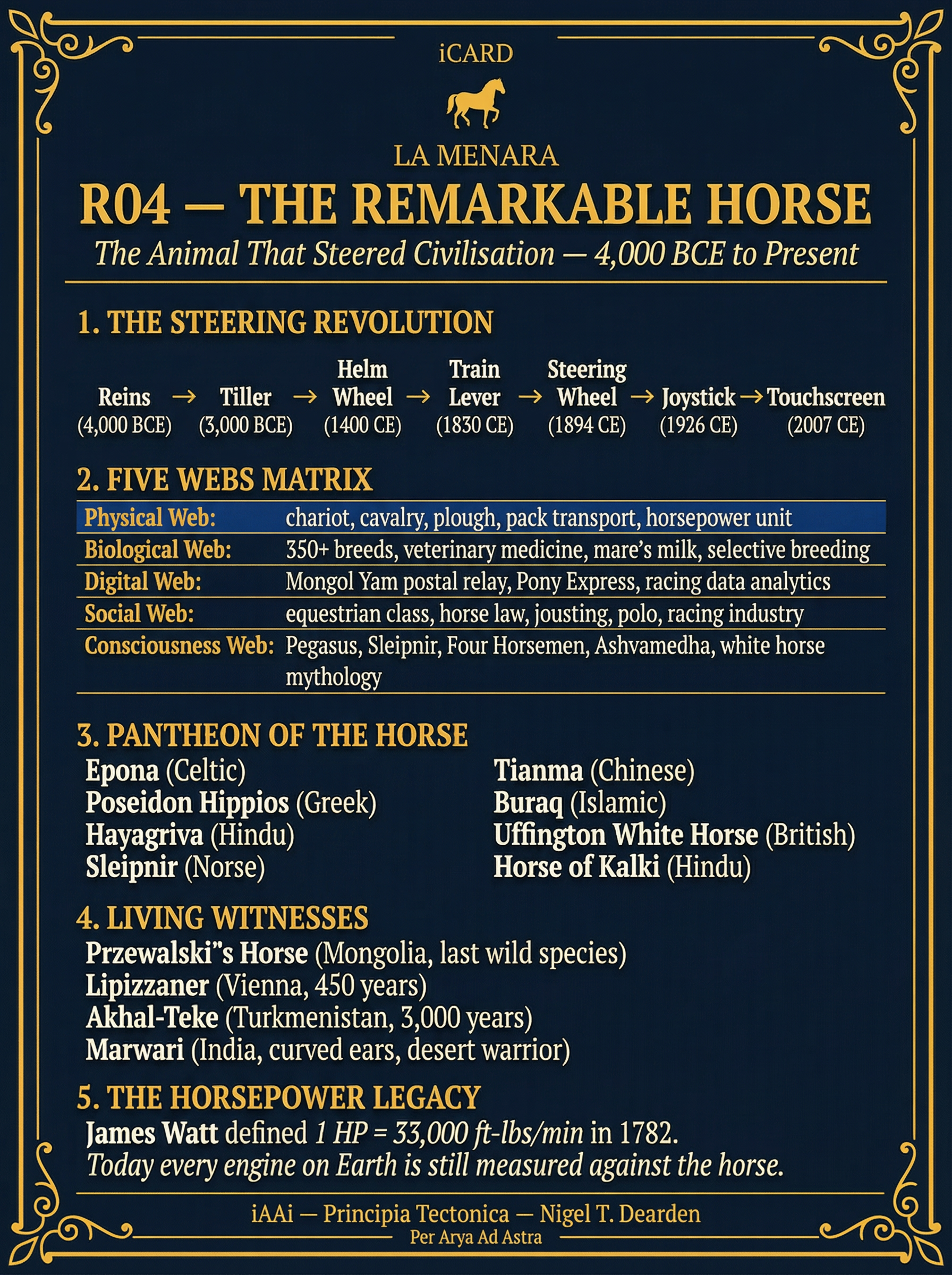
iCard — La Menara R04: The Remarkable Horse
THE COUNTERPARTS: HORSE
How West, East, and Outrider each approached horse infrastructure

The Counterparts — Relay 04: Horse