RELAY 1: FIRE
Ignition — The Composer
Twelve thousand years ago, a great change erupted of unimaginable proportions. In an explosion of intent, man rose from hunter and prey to apex predator. The seed was sown, the threads spun, and the age of intelligence began. Civilisation ignited — an epic of incalculable possibility. United, mankind could build the impossible, raising cathedrals in the sky and unlocking the ethereal depths of our being. Division brings collapse, but unification multiplies strength — the grand design that lifts us toward higher intelligence and higher learning. What can be imagined may now be achieved, for imagination itself has become infrastructure.
ACTIVE WEBS
ENERGY WEB
Controlled energy source for survival and expansion
KNOWLEDGE WEB
Transmission of fire-making and fire-tending knowledge
ICUT FOUR PILLARS
INFRASTRUCTURE
Hearths, fire-pits, and fire-tending systems
CONTINUITY
Maintaining fire across generations and seasons
UNIFICATION
The hearth as gathering place for community
THREATS
Fire loss, uncontrolled fire, environmental challenges
HISTORICAL SIGNIFICANCE
Timeline: Approximately 400,000 to 1 million years ago, depending on the definition of "controlled" fire use.
Impact: Fire enabled human migration to colder climates, improved nutrition through cooking, enabled tool-making, and created the first shared infrastructure systems around hearths and gathering places.
Legacy: Fire remains central to human civilisation. From fireplaces to power plants, from cooking to industrial processes, fire infrastructure continues to shape human society.
LA MENARA — THE REMARKABLE FIRE
The cultural, mythological, and spiritual significance of fire across civilisations
"Man is the only creature that dares to light a fire and live with it." — Henry Jackson Van Dyke
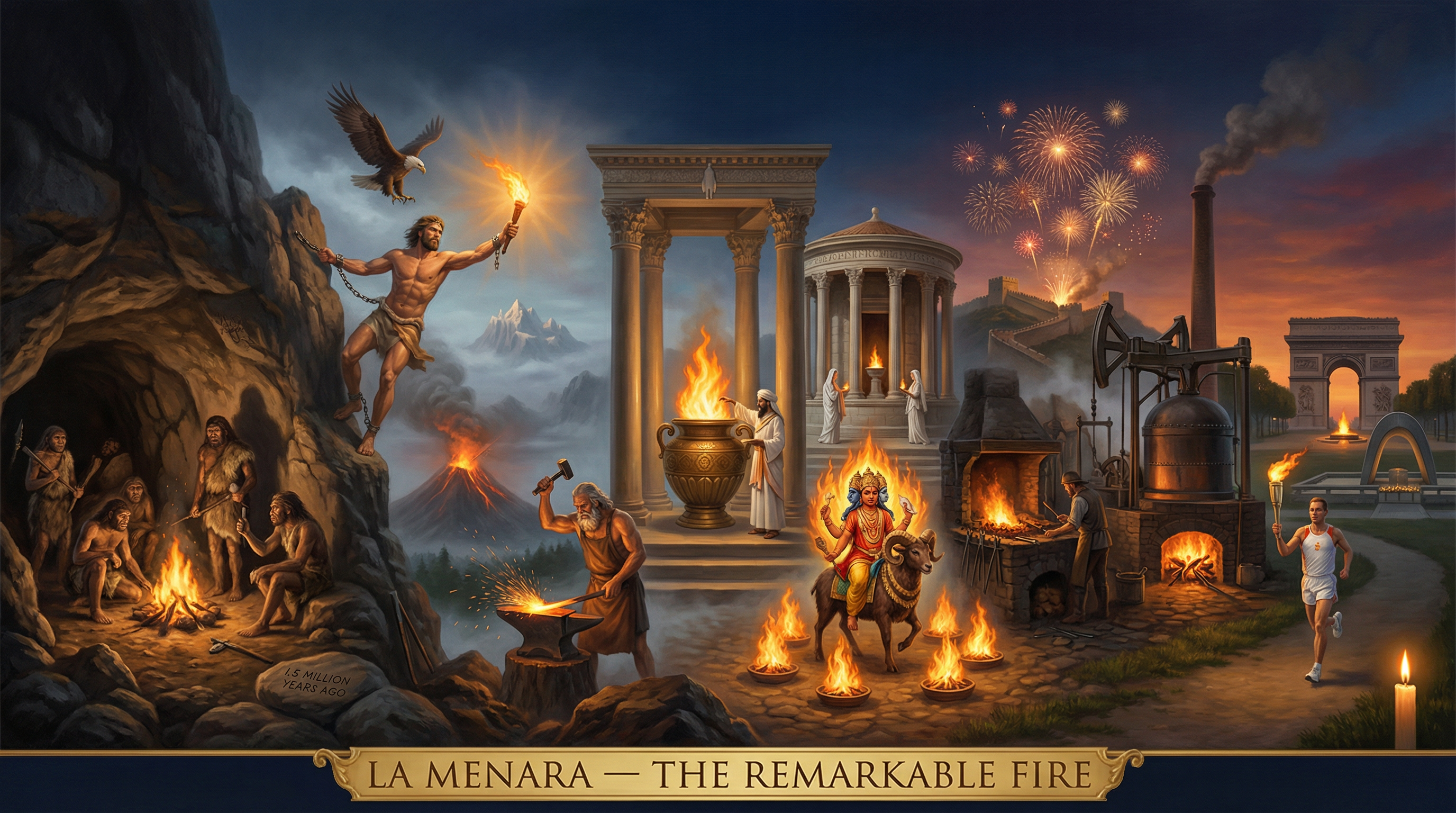
La Menara — The Cultural History of Fire: From Wonderwerk Cave to the Olympic Flame
Of all the civilisational relays that carry humanity forward, fire stands alone as the original. It is not merely the first tool but the first platform — the substrate upon which every subsequent relay depends. Without fire there is no cooked food, no smelted metal, no fired pottery, no cleared land, no light after dark. Homo erectus first controlled fire approximately 1.5 million years ago at Wonderwerk Cave in South Africa, making it the longest-running technology in human history.
Every major civilisation created fire deities reflecting this centrality: Prometheus stole fire from Olympus for humanity and was punished by Zeus. Agni, the Vedic fire god, has over 200 hymns in the Rigveda and manifests in three forms — earthly, celestial, and digestive. Zhurong taught the Chinese to harness fire. Pele shapes Hawaii through volcanic creation. Shango breathes fire but stands for justice in the Yoruba tradition. The pattern is universal: fire deities embody creation and destruction simultaneously.
Fire is also the original multi-output processing infrastructure. One element enables cooking, smoking, drying, rendering, fermentation, distillation, sugar refining, and salt production — eight derivative technologies from a single source. Richard Wrangham argues in Catching Fire (2009) that cooking was the decisive event in human evolution: it released more bioavailable calories, enabled a smaller gut and larger brain, and created the social gathering space around the hearth.
The temperature ladder tells the engineering story: 600°C for pottery (25,000 BCE), 1,085°C for copper (5,000 BCE), 1,538°C for iron (1,200 BCE), 2,000°C for internal combustion (1876 CE). Each step unlocked a new material, a new capability, and a new era of civilisation. Fire is not just the first relay — it is the enabling condition for relays 3 through 12.
Perhaps most profoundly, fire's cultural significance lives on in eternal flames that have never been extinguished: the Zoroastrian Atash Behram in Yazd has burned for ~1,550 years. The Arc de Triomphe flame has been rekindled every evening at 6:30 PM since 1923 — including throughout the German occupation of Paris. The Hiroshima Peace Flame will burn until every nuclear weapon on Earth is eliminated. Fire — the first technology — stands as witness to the last technology of destruction.
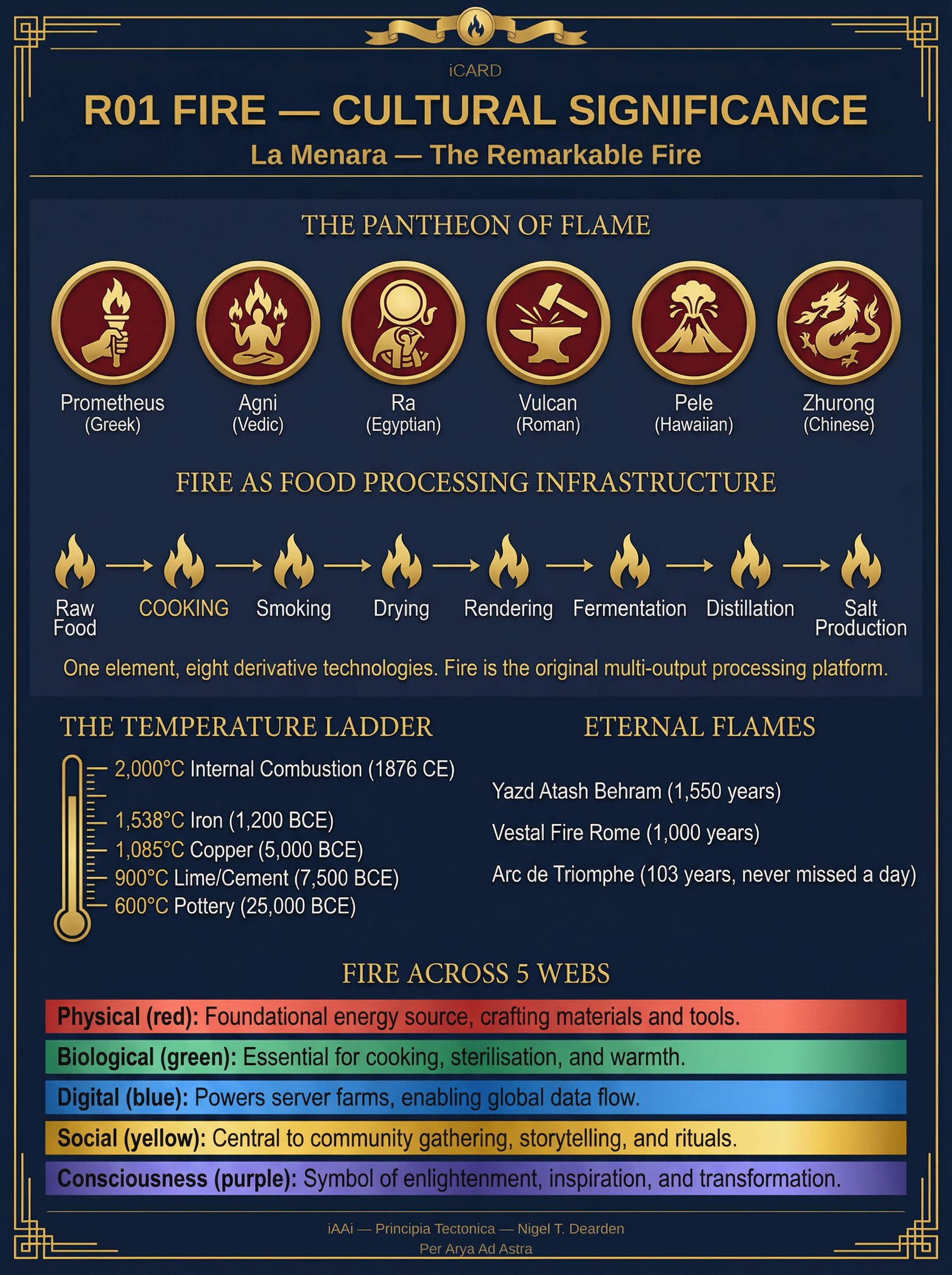
iCard R01 — Fire: Cultural Significance
THE COUNTERPARTS: FIRE
How West, East, and Outrider each approached fire infrastructure

The Counterparts — Relay 01: Fire